The Canine Leishmania Antibody Rapid Test Kit is a lateral flow immunochromatographic device engineered for the in vitro qualitative detection of anti-Leishmania infantum IgG antibodies in canine serum, plasma, or whole blood. This test is central to the epidemiological surveillance, clinical diagnosis, and public health risk assessment of canine visceral leishmaniasis (CVL) — a zoonotic vector-borne disease with expanding global distribution.
Canine leishmaniasis, caused by the protozoan parasite Leishmania infantum, is recognized by the Centers for Disease Control and Prevention (CDC) as a neglected parasitic disease (NPD) with both animal and human health consequences. The CDC reports that infected dogs serve as primary reservoirs for zoonotic transmission via Phlebotomus or Lutzomyia sandflies.
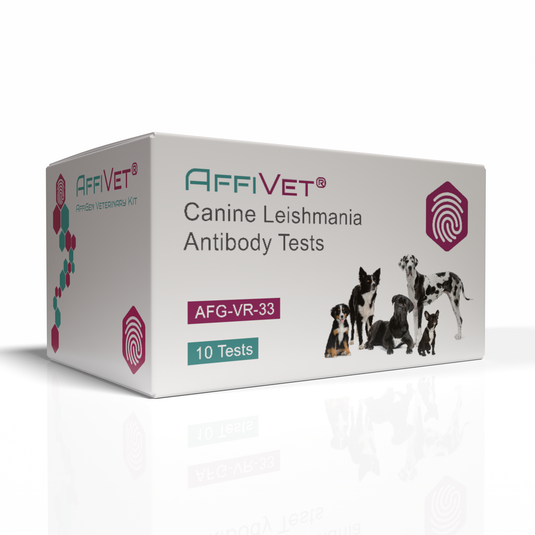
Immunodiagnostic Principle and Kit Structure
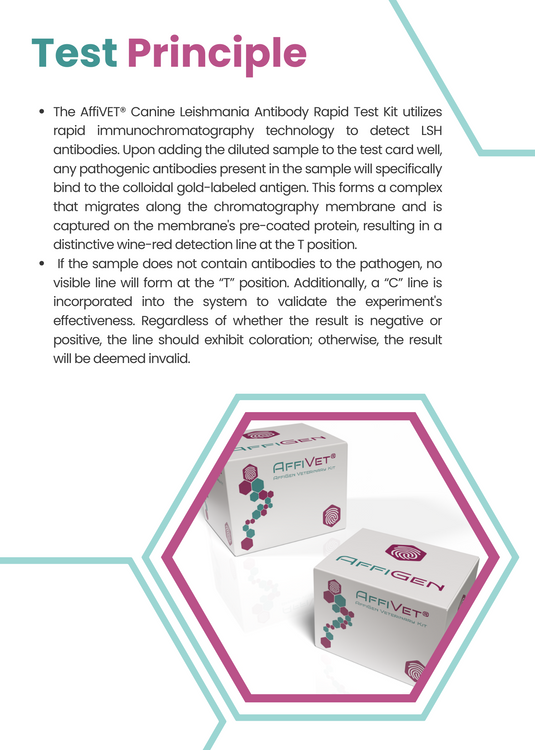
The test utilizes recombinant K39 (rK39) antigen, a conserved immunodominant epitope derived from the kinesin-related gene of L. infantum, immobilized on a nitrocellulose membrane. When canine blood is added, any specific anti-Leishmania antibodies bind to gold-labeled anti-canine IgG conjugates, forming a complex that migrates via capillary action to a capture line. A visible red/purple band indicates a positive result.
This diagnostic mechanism is supported by research from PubMed Central and the National Institutes of Health (NIH), confirming high analytical sensitivity and specificity in endemic settings.
Key Technical Specifications
| Parameter | Specification |
|---|---|
| Target | Leishmania infantum IgG antibodies |
| Antigen Used | Recombinant K39 protein |
| Sample Type | Whole blood, serum, or plasma |
| Detection Limit | 20–50 ng/mL of specific IgG |
| Analytical Sensitivity | 96.7% – 98.5% (varies by geographic strain) |
| Analytical Specificity | ≥ 98.5% (confirmed via reference tests) |
| Shelf Life | 18–24 months at 2–30°C |
| Result Time | 10–15 minutes |
| Storage Conditions | Room temperature; avoid moisture and freezing |
| Visual Indicator | Dual line: Test and Control |
For validation protocols, refer to the U.S. Food and Drug Administration Veterinary Diagnostics Program.
Clinical Use Cases
-
Routine screening of dogs in endemic zones
-
Diagnostic confirmation in symptomatic canines (alopecia, weight loss, epistaxis, lymphadenopathy)
-
Import/export health certificate testing (USDA APHIS)
-
Pre-travel quarantine protocols enforced by the CDC
-
Pre-donation screening for canine blood donors (Cornell Vet)

Zoonotic Risk and Public Health Context
Canine visceral leishmaniasis is a zoonosis of increasing global relevance, with dog-to-human transmission documented in both urban and peri-urban zones. The World Health Organization (WHO) notes rising cases in southern Europe, Latin America, and parts of the United States.
Zoonotic risk assessments by the National Center for Emerging and Zoonotic Infectious Diseases (NCEZID) classify Leishmania infantum as a priority pathogen due to its chronic progression and immunosuppressive interactions in both human and animal hosts. Asymptomatic dogs pose epidemiological challenges, necessitating mass screening with rapid kits.
Laboratory Confirmation and Limitations
While rapid antibody kits are valuable for initial field diagnostics, false positives can occur due to cross-reactivity with other hemoparasites, such as:
-
Ehrlichia canis
-
Anaplasma platys
-
Babesia canis
Confirmatory testing via ELISA, IFAT, or qPCR is recommended, as supported by protocols from the University of California Davis School of Veterinary Medicine and Tufts University Cummings School of Veterinary Medicine.
Storage, Transport, and Biosafety
The test kits are categorized as non-hazardous diagnostic devices under U.S. Department of Transportation (DOT) shipping classifications. For international compliance, veterinary institutions should follow OIE guidelines and biosafety protocols available from USDA NAHLN.
Surveillance and Regulatory Framework
Numerous national and university veterinary programs integrate Leishmania antibody testing into their routine canine disease surveillance systems, including:
Additionally, epidemiological data is monitored via CDC One Health and NIH RePORTER, which fund ongoing studies on emerging zoonotic leishmaniasis.
Global Expansion and Emerging Strains
Rising climate change, urbanization, and international canine relocation have accelerated the emergence of new Leishmania transmission zones in North America and Asia. Surveillance data published by the National Library of Medicine (NLM) and the U.S. Geological Survey (USGS) confirm sandfly migration and novel vector-pathogen-host interfaces.
For interactive maps and disease distribution, consult the CDC Global Health – Leishmaniasis Surveillance.
Conclusion: Technological Integration for One Health Diagnostics
The Canine Leishmania Antibody Rapid Test Kit bridges the gap between point-of-care veterinary diagnostics and public health surveillance. It is an integral part of One Health strategies, enabling early detection, mass screening, and zoonotic disease containment.
Supported by NIH/NIAID, WHO Tropical Disease Research (TDR), and leading veterinary schools, the kit continues to serve as a frontline tool for canine and zoonotic leishmaniasis detection.
Veterinary labs and clinics are advised to integrate rapid test screening into routine diagnostics, consult the American Association of Veterinary Laboratory Diagnosticians (AAVLD), and align with international disease reporting frameworks to ensure early intervention and cross-species prevention.