The Human CD248 (Endosialin) ELISA Kit is a specialized assay used to measure CD248, also known as Endosialin, in biological samples such as serum, plasma, or cell culture supernatants. CD248 is a cell surface glycoprotein predominantly expressed in pericytes, stromal cells, and tumor-associated vasculature. It plays a critical role in tissue remodeling, angiogenesis, and tumor progression, making it a valuable biomarker in cancer, inflammation, and fibrotic diseases. This article provides a comprehensive overview of the kit, its applications, and its role in advancing biomedical research.
What is CD248 (Endosialin)?
CD248, also referred to as Endosialin or tumor endothelial marker-1 (TEM-1), is a type I transmembrane glycoprotein. It is prominently expressed in perivascular cells and activated fibroblasts during inflammation, tissue repair, and cancer progression. CD248 is implicated in cell adhesion, migration, and extracellular matrix remodeling, making it a key player in pathological processes.
For additional information on CD248, visit the National Center for Biotechnology Information (NCBI) or PubMed.
Clinical Significance of CD248 (Endosialin)
1. Cancer Research
CD248 is highly expressed in the tumor microenvironment, particularly in tumor-associated fibroblasts and pericytes, contributing to angiogenesis and tumor progression. It is a potential target for cancer therapies, including those aimed at disrupting the tumor vasculature. For more details, visit the National Cancer Institute (NCI).
2. Fibrotic Diseases
CD248 is upregulated in fibrotic diseases such as pulmonary fibrosis and liver fibrosis, where it regulates fibroblast activation and extracellular matrix deposition. Learn more from the National Institute of Diabetes and Digestive and Kidney Diseases (NIDDK).
3. Inflammatory Disorders
Increased expression of CD248 has been observed in chronic inflammatory conditions, including rheumatoid arthritis and inflammatory bowel disease (IBD). For more resources, visit the National Institute of Arthritis and Musculoskeletal and Skin Diseases (NIAMS).
Applications of the Human CD248 ELISA Kit
The Human CD248 ELISA Kit is a versatile tool with numerous applications in research and diagnostics:
1. Cancer Biomarker Research
The kit enables researchers to quantify CD248 levels in tumors and monitor its association with disease progression and therapy response. For information on biomarkers, explore NIH Biomarker Research.
2. Fibrosis Studies
Quantifying CD248 levels in fibrotic tissue provides insights into its role in fibrosis development and potential therapeutic targeting. Guidelines for fibrosis research can be found at NIH Fibrosis Network.
3. Drug Development
The kit is instrumental in evaluating the efficacy of anti-CD248 therapies in preclinical and clinical studies. For details on drug development, visit ClinicalTrials.gov.
4. Translational Research
The kit facilitates research translating into clinical applications, such as diagnostics and personalized therapies. Learn more from NIH Translational Research Resources.
Features of the Human CD248 ELISA Kit
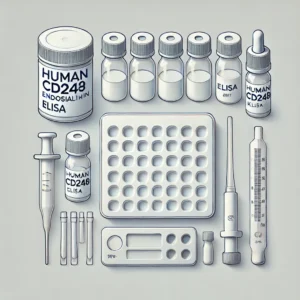
- High Sensitivity and Specificity: Detects low levels of CD248 with minimal cross-reactivity.
- Wide Dynamic Range: Suitable for detecting a broad range of CD248 concentrations.
- User-Friendly Protocol: Includes pre-coated plates and ready-to-use reagents for easy setup.
- Sample Compatibility: Validated for use with serum, plasma, and cell culture supernatants.
- Quantitative Results: Provides accurate and reproducible measurements.
How the Human CD248 ELISA Kit Works
The enzyme-linked immunosorbent assay (ELISA) is a plate-based method that uses antigen-antibody interactions to detect specific proteins. The key steps in the CD248 ELISA are:
- Antigen Capture: The microplate is pre-coated with a capture antibody specific to CD248.
- Sample Addition: Biological samples containing CD248 are added to the wells.
- Binding Reaction: CD248 binds to the capture antibody.
- Detection: A biotin-conjugated detection antibody binds to the captured antigen.
- Signal Amplification: Enzyme-linked streptavidin reacts with a substrate to produce a colorimetric signal proportional to the CD248 concentration.
For technical details, refer to the NIH Assay Guidance Manual.
Advantages of the Human CD248 ELISA Kit
- Rapid Turnaround Time: Results are available within 2-3 hours.
- High Throughput Capability: Ideal for analyzing multiple samples simultaneously.
- Reproducibility: Delivers consistent results across experiments.
- Cost-Effective: Provides an affordable solution compared to advanced imaging and mass spectrometry.
Challenges and Future Directions
1. Standardization
Variability in assay conditions and sample handling can affect results. Efforts to standardize ELISA protocols are underway at NIST.
2. Emerging Technologies
Complementary technologies, such as multiplex assays and next-generation sequencing, are being developed to enhance biomarker discovery. Learn more at NIH Proteomics Research.
3. Therapeutic Development
Ongoing research aims to develop anti-CD248 therapies for cancer and fibrosis. Explore recent advancements at Science.gov.
Conclusion
The Human CD248 (Endosialin) ELISA Kit is a powerful tool for advancing research in cancer, fibrosis, and inflammation. By enabling the precise quantification of CD248 levels, this assay supports the development of new diagnostics and therapeutics, ultimately contributing to improved patient outcomes.
For additional resources, visit: