Introduction
The intricate balance of DNA topology is a cornerstone of cellular function. DNA supercoiling, critical for replication, transcription, and repair, is regulated by a class of enzymes known as topoisomerases. E. coli DNA Topoisomerase I, in particular, is pivotal for managing negative supercoiling in bacterial DNA. The E. coli DNA Topoisomerase I Assay Kit Plus offers unparalleled precision and convenience, empowering researchers to delve deeper into DNA dynamics. This article explores the assay’s features, applications, and the scientific principles it supports, with resources from leading educational and governmental organizations.

The Science Behind E. coli Topoisomerase I
Topoisomerase I, a type I topoisomerase, prevents excessive negative supercoiling by transiently nicking one strand of the DNA helix, allowing the strand to unwind, and subsequently resealing it. This enzyme’s unique activity ensures proper DNA transcription and replication.
Inhibiting this enzyme can disrupt bacterial DNA dynamics, making it an attractive target for antimicrobial drug development. Read about antimicrobial strategies.
Key Features of the E. coli DNA Topoisomerase I Assay Kit Plus
- Enhanced Sensitivity
The assay kit’s robust formulation ensures precise detection of enzyme activity, even at low concentrations.
Learn about sensitivity in enzymatic assays. - Versatility Across Applications
From academic research to pharmaceutical development, this assay kit facilitates diverse experimental needs.
Discover applications in pharmaceutical sciences. - Complete Reagent Set
With optimized buffers and supercoiled DNA substrates, the kit minimizes preparation time and maximizes reliability.
Explore the role of reagents in biochemical assays.
Applications in Modern Research
- Antibiotic Discovery
The assay is invaluable for screening inhibitors targeting bacterial topoisomerases, aiding in the fight against antimicrobial resistance. - Mechanistic Enzyme Studies
Researchers can use the assay to dissect the mechanistic details of topoisomerase-mediated DNA relaxation. - Teaching and Training
The straightforward design of this kit makes it an excellent tool for hands-on learning in molecular biology courses. - Structural Biology
Characterizing the interaction of Topoisomerase I with inhibitors or DNA is essential for structural studies.

Workflow of the Assay
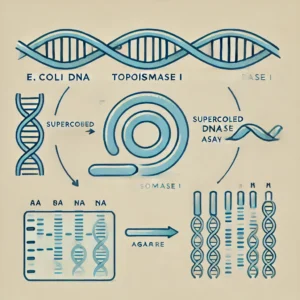
The E. coli DNA Topoisomerase I Assay Kit Plus provides a seamless protocol for detecting enzyme activity:
- Supercoiled DNA Substrate Preparation
The kit includes high-quality supercoiled plasmid DNA, essential for consistent results. - Enzyme Reaction
DNA is incubated with E. coli Topoisomerase I in the presence of the assay buffers, allowing for relaxation activity. - Electrophoretic Analysis
Post-reaction, DNA samples are analyzed via agarose gel electrophoresis, revealing relaxed and supercoiled DNA bands. - Quantification
DNA band intensity can be quantified using imaging software, enabling precise measurements of enzyme activity.
Advantages Over Conventional Assays
- Efficiency: Minimal preparation time due to pre-optimized reagents.
Standardization in molecular assays. - Accuracy: Enhanced sensitivity for detecting subtle variations in enzyme activity.
Explore precision in biochemical assays. - Scalability: Suitable for both small-scale academic studies and high-throughput industrial applications.
Applications of high-throughput screening.
Future Directions in Topoisomerase Research
- Therapeutic Development
Using the assay, researchers can screen for novel inhibitors to combat drug-resistant bacterial strains. - Understanding DNA Topology
Further studies using this kit could elucidate the role of DNA supercoiling in transcriptional regulation. - Integration with Other Technologies
Combining this assay with next-generation sequencing or CRISPR technology could provide new insights into bacterial genome dynamics.
Conclusion
The E. coli DNA Topoisomerase I Assay Kit Plus is an indispensable tool for advancing research in molecular biology, antimicrobial drug development, and genomic stability. Its precise, user-friendly design ensures reliable and reproducible results across applications. Leveraging this kit will enable researchers to explore new frontiers in understanding DNA dynamics and enzymatic mechanisms.
For more resources, visit: