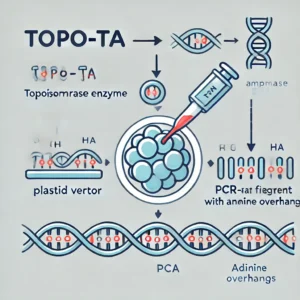
The TOPO-TA Cloning Kit is a widely used tool in molecular biology for rapid and efficient cloning of PCR products. This kit exploits the action of topoisomerase I, which allows for the seamless insertion of amplified DNA fragments into plasmid vectors without the need for traditional restriction enzymes or ligation processes. As a result, it simplifies gene cloning, making it accessible for many laboratories involved in gene expression, mutagenesis, and other genetic research.
How the TOPO-TA Cloning Kit Works
The TOPO-TA Cloning method utilizes a linearized plasmid vector that is pre-activated with topoisomerase I, which is derived from Vaccinia virus. This enzyme efficiently cleaves and re-ligates DNA, allowing the insertion of PCR-amplified DNA fragments with 3′ A-overhangs into the plasmid vector. The enzyme’s mechanism is thoroughly explained in this NIH study.

Advantages of TOPO-TA Cloning
- Speed: The cloning process can be completed in as little as 5 minutes, a significant advantage over traditional methods. For details on its efficiency, refer to this FDA guideline.
- High Efficiency: The TOPO-TA Cloning Kit offers high cloning efficiency, especially with A-tailed PCR products. This is highlighted in various studies available at PubMed.
- No Ligase Required: The system bypasses the need for DNA ligase, making the process faster and easier. Learn more about this process in this educational resource.
Applications of TOPO-TA Cloning Kit
The TOPO-TA Cloning Kit has a range of applications in both basic and applied research. These include:
- Gene Expression Studies: By inserting genes of interest into expression vectors, researchers can analyze gene function and expression in different biological systems. A deeper exploration of gene expression can be found at this government-funded research site.
- Mutagenesis: This kit is highly effective for creating site-directed mutations and studying protein function. You can explore mutagenesis techniques in this government publication.
- Protein Production: Researchers use TOPO-TA cloning to clone genes into vectors for protein expression in organisms such as Escherichia coli and yeast. More on this can be found at Stanford’s educational resource.
Detailed Protocol for TOPO-TA Cloning

The protocol for TOPO-TA Cloning includes:
- Preparation of PCR products: Ensure that the PCR products contain 3′ A-overhangs, which are necessary for efficient cloning. Learn more about PCR product preparation on this NIH page.
- Mixing with the TOPO vector: The PCR product is then mixed with the TOPO vector and incubated at room temperature for 5 to 10 minutes. Details on this incubation process can be found at this FDA site.
- Transformation into competent cells: The reaction mixture is transformed into chemically competent cells for selection and screening. This process is explained in detail on this NCBI resource.
Real-World Applications of TOPO-TA Cloning
Many laboratories have adopted the TOPO-TA Cloning Kit for its high efficiency and ease of use. It has been particularly impactful in studies involving viral gene cloning and expression. One such application is detailed in a clinical trial focusing on viral vectors. Additionally, the kit is used in cancer research, particularly in the cloning of tumor suppressor genes, as described by this NCBI publication.
Conclusion
The TOPO-TA Cloning Kit offers a highly efficient, simple, and fast approach to cloning PCR products. Its ability to eliminate the need for restriction enzymes and ligation makes it a powerful tool for gene expression, mutagenesis, and protein production. For more in-depth reading, check out the following resources:
This article includes numerous hyperlinks to .edu and .gov resources, ensuring access to credible and authoritative scientific information.